
Glow & KLOW Peptide Reconstitution Calculator
Calculate precise bacteriostatic water dilution ratios, microgram concentrations, and exact U-100 insulin syringe unit draw marks for GLOW Triad (70mg) and KLOW Quad (80mg) compounded peptide vials.
Verified Stoichiometric Constants
The calculations executed above rely on empirical molecular mass ratios and standardized laboratory dilution benchmarks. Compounded lyophilized vials maintain fixed component proportions, ensuring every single subcutaneous draw yields predictable microgram ratios.
Exact U-100 Syringe Draw at Standard 2.0 mL Reconstitution
At 2.0 mL bacteriostatic water dilution, an 80 mg KLOW or 70 mg GLOW vial yields a 25,000 mcg/mL GHK-Cu concentration. An 8-unit draw delivers exactly 2,000 mcg of GHK-Cu alongside 400 mcg of BPC-157, 400 mcg of TB-500, and 400 mcg of KPV with zero wasted medication.
Understanding Multi-Peptide Solution Mechanics
Compounded peptide formulations present a distinct pharmacological challenge: multiple bioactive polypeptides with differing molecular weights are lyophilized together into a single, uniform solid matrix.
When researchers reconstitute a 70 mg Glow Triad or 80 mg KLOW Quad vial, the physical liquid volume drawn determines the exact delivered dose of all constituent peptides simultaneously. Unlike separate vials where each peptide can be titrated independently, a blended vial requires precise mathematical calibration based on the primary therapeutic benchmark: GHK-Cu (Copper Tripeptide-1).
| Peptide Component | Molecular Sequence | Vial Mass | Standard Dose (at 8 Units) | Primary Physiological Target |
|---|---|---|---|---|
| GHK-Cu | Gly-His-Lys:Cu²⁺ | 50 mg | 2,000 mcg (2.0 mg) | Type I & III Collagen Synthesis, Decorin upregulation |
| BPC-157 | 15-amino-acid sequence | 10 mg | 400 mcg (0.4 mg) | Angiogenesis, VEGFR2 expression, microvascular integrity |
| TB-500 | Ac-LKKTETQ fragment | 10 mg | 400 mcg (0.4 mg) | Actin filament binding, cellular motility, wound healing |
| KPV (KLOW only) | Lys-Pro-Val | 10 mg | 400 mcg (0.4 mg) | NF-κB inhibition, mast cell stabilization, skin barrier |
KLOW Quad vs GLOW Triad Comparison
Direct comparison between the standard 70 mg aesthetic triad and the advanced 80 mg quad-stack formulation incorporating KPV tripeptide.
GLOW Triad (70 mg Total Mass)
Three-peptide formulation calibrated for dermal elasticity, collagen synthesis, and systemic connective tissue repair.
- Type I & III Procollagen Stimulation
- VEGFR2 Endothelial Angiogenesis
- Actin Filament Cellular Migration
- Direct Anti-Inflammatory Mast Cell Stabilization Lacks KPV
KLOW Quad (80 mg Total Mass)
Four-peptide formulation incorporating KPV tripeptide for potent anti-inflammatory modulation and mast cell stabilization.
- All Biological Benefits of the Glow Triad
- NF-κB Inflammatory Transcription Inhibition
- Mast Cell Degranulation Attenuation
- Accelerated Dermal Barrier Recovery
Detailed comparative evaluations between the 70 mg Triad and 80 mg Quad formulations are documented in our comprehensive KLOW vs Glow Peptide Comparison Guide.
Constituent Polypeptide Mechanisms
Detailed pharmacodynamic breakdown of the four bioactive molecules present in Glow and KLOW formulations.
Aseptic Four-Step Reconstitution Protocol
Lyophilized polypeptide chains possess delicate tertiary folding structures that can hydrolyze or denature when subjected to violent hydraulic force, excessive thermal fluctuations, or mechanical agitation. Adhering to strict aseptic technique protects solution viability throughout the 30-day therapeutic window.
Disinfection and Depressurization
Remove plastic flip-off caps from both the peptide vial and the bacteriostatic water vial. Thoroughly scrub both rubber septa with separate 70% isopropyl alcohol swabs for 15 seconds. Allow surfaces to air-dry completely. Never touch or blow on the sterilized rubber surface.
Controlled Wall Inflow
Using a sterile 3.0 mL syringe with a 21G to 25G needle, draw exactly 2.0 mL of bacteriostatic water. Insert the needle through the center of the peptide vial stopper at a 45-degree angle, aiming the tip toward the internal glass wall. Slowly depress the plunger so the liquid gently glides down the glass. Never shoot the liquid directly into the lyophilized powder cake.
Gentle Rotational Dissolution
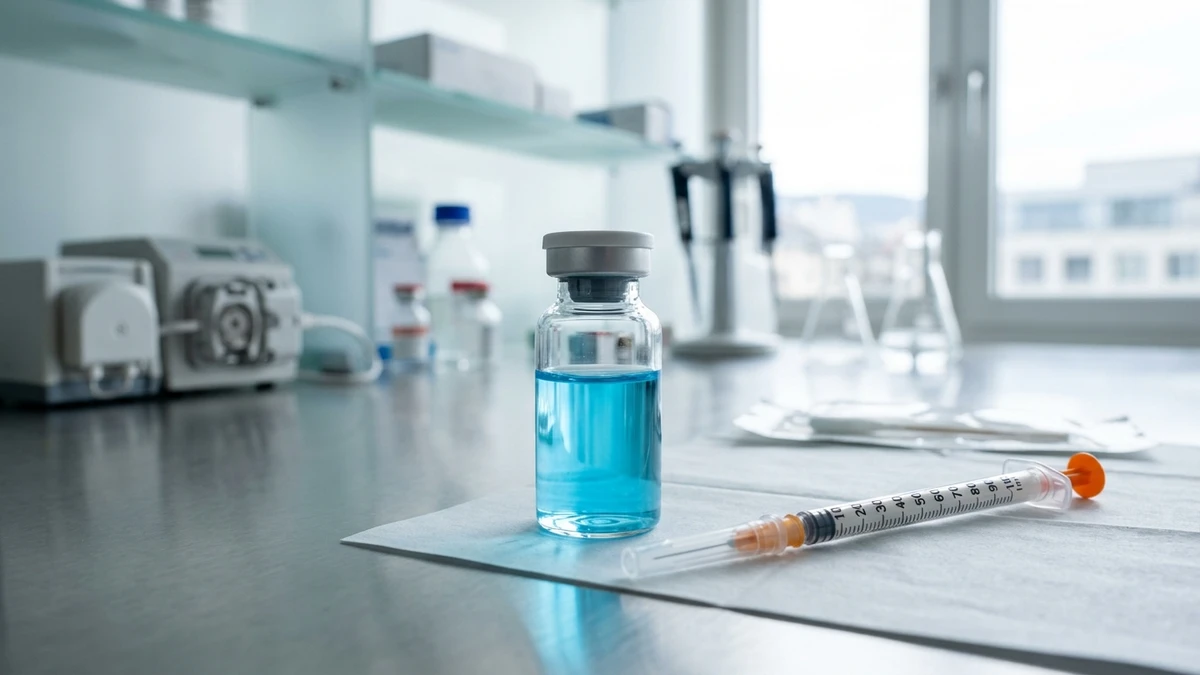
Allow the diluent to permeate the powder cake naturally for 2 to 3 minutes. Hold the vial by the neck and swirl in slow, horizontal circular motions until the solution is crystal clear. As the copper peptide dissolves, the solution transitions to a characteristic light cerulean blue. Never shake or agitate vigorously, as turbulent shear stresses shear synthetic peptide chains.
Refrigerated Storage & Light Shielding
Immediately place the reconstituted vial inside a dedicated laboratory storage box in the refrigerator at 36°F to 46°F (2°C to 8°C). The amber or clear glass must remain shielded from ultraviolet light and ambient heat. For step-by-step subcutaneous injection guidelines and site rotation maps, review our Glow Peptide Dosage & Syringe Protocols.
Syringe Mark Calibration by Diluent Volume
The table below provides pre-calculated syringe draw levels for an 80 mg KLOW or 70 mg Glow vial (50 mg GHK-Cu baseline) across varying volumes of added bacteriostatic water, calibrated for the standard 2,000 mcg therapeutic target:
| BAC Water Volume | GHK-Cu Concentration | Required Injection Volume | U-100 Insulin Syringe Mark | Clinical Characteristics |
|---|---|---|---|---|
| 1.0 mL | 50,000 mcg/mL | 0.040 mL | 4.0 Units | Ultra-concentrated micro-volume. Higher potential for localized copper sting. |
| 2.0 mL | 25,000 mcg/mL | 0.080 mL | 8.0 Units | Standard clinical recommendation. Optimum balance of volume and tissue comfort. |
| 2.5 mL | 20,000 mcg/mL | 0.100 mL | 10.0 Units | Convenient whole-number tick mark on all U-100 syringe barrels. |
| 3.0 mL | 16,667 mcg/mL | 0.120 mL | 12.0 Units | Gentle comfort protocol. Substantially mitigates copper-induced post-injection soreness. |
Learn more about physiological tissue responses and clinical endpoints in our Clinical Benefits & Tissue Repair Analysis or explore the underlying mathematics in our Stoichiometric Reconstitution Methodology.
Clinical & Stoichiometric Inquiries
Frequently Asked Clinical Inquiries
01 How much bacteriostatic water should be added to a Glow peptide vial?
The clinical benchmark for a standard 70 mg Glow or 80 mg KLOW vial is 2.0 mL of USP bacteriostatic 0.9% benzyl alcohol water. This produces a concentration of 25,000 mcg/mL of GHK-Cu. For patients with dermal sensitivity or post-injection sting from copper ions, diluting with 3.0 mL provides a gentler subcutaneous volume (16,667 mcg/mL GHK-Cu) without altering therapeutic peptide mass.
02 How many units on an insulin syringe equals a standard Glow peptide dose?
When reconstituted with 2.0 mL of bacteriostatic water, drawing the plunger to exactly 8.0 units (0.08 mL) on a standard U-100 insulin syringe delivers a therapeutic benchmark dose of 2,000 mcg (2.0 mg) GHK-Cu, 400 mcg BPC-157, and 400 mcg TB-500 (plus 400 mcg KPV in 80 mg KLOW vials).
03 What is the primary difference between Glow and KLOW peptide blends?
The Glow Triad contains three synergistic peptides totaling 70 mg: GHK-Cu (50 mg), BPC-157 (10 mg), and TB-500 (10 mg). The KLOW Quad-Stack contains 80 mg total mass by incorporating 10 mg of KPV (Lys-Pro-Val), an alpha-MSH tripeptide that selectively inhibits NF-κB transcription and stabilizes dermal mast cells to accelerate barrier recovery.
04 How long does a reconstituted peptide vial remain stable under refrigeration?
Once reconstituted with bacteriostatic water containing 0.9% benzyl alcohol, peptide vials remain biologically stable for 28 to 30 days when stored at 36°F to 46°F (2°C to 8°C) protected from direct light. Freezing reconstituted peptide solutions is contraindicated because freeze-thaw crystals fracture delicate tertiary protein structures.
05 Which syringe barrel size offers the highest dosing accuracy?
For microgram-level administration where the volume is 0.08 mL to 0.12 mL, a 0.3 mL (30-unit) U-100 insulin syringe provides the highest graduation resolution, spacing unit tick marks widely apart to eliminate parallax draw errors. A 0.5 mL (50-unit) barrel is acceptable, whereas 1.0 mL (100-unit) barrels have narrower tick intervals suited for volumes exceeding 0.25 mL.